Two days to fix the wayfinding in a 1,200-hectare forest.
We couldn't build anything: the park is protected land. So we spent day one walking it as three different visitors, and day two arguing about trails. What we pitched used Anna Brigadere's fairytale as the navigation system, and it won.

Five objectives, 48 hours, and one rule that removed the obvious answer.
Dabas Parks Tērvete is a 1,200 ha forest park in Latvia, built around the fairytale world of writer Anna Brigadere (1861–1933) and the woodcraft tradition that has shaped it since its first trails opened in 1958. It is one of the country's most-visited parks, and its owner, Latvijas Valsts Meži (LVM), wants it to become Latvia's leading forest experience for international audiences.
LVM asked teams to redesign the park's wayfinding and small architectural forms against five objectives: improve navigation, encourage return visits, attract international audiences, create new revenue streams, and expand beyond families and school groups. Then came the constraint that shaped everything. The park sits in a Natura 2000 protected area with 72 protected species, so we couldn't build our way out of the problem. Whatever we proposed had to live in the service layer.
Format
SDSI Hackathon, 2026 · 48 hours
My role
Service Designer & UX Researcher · Originated the personalised trail system and the artist residency concept
Team
Catherine Martin, Sara Sanwal, Fanny Verástegui (Team Gnomes)
Deliverables
0
visitors in 2025, a record and one of Latvia's most popular parks
0 ha
total park area, with 200 ha paid-access across six thematic zones
0
protected species on site, under the park's Natura 2000 designation
0%
of visitors are families or preschool children, the segment LVM wants to grow beyond
Three hours, one map, and no instructions.
Every team was handed the same visitor map and turned loose in the park. That was the research budget.
Rather than walk it as ourselves, we split the park three ways and walked it as the visitors LVM cared about. One of us moved through asking what a child would stop for. One asked what would make the trip worth it for an adult with no kids in tow. One asked what a person with accessibility needs could actually reach, on these surfaces, in this much time. Same park, same three hours, three completely different shortlists, and almost no overlap between them.
As a child
What would stop a seven-year-old? The gnomes, the slide, anything you can climb on or touch.
As an adult
What makes the drive worth it if you're not bringing kids? Far less than we expected.
As someone with accessibility needs
What can you actually reach on foot, on these surfaces, in this much time?
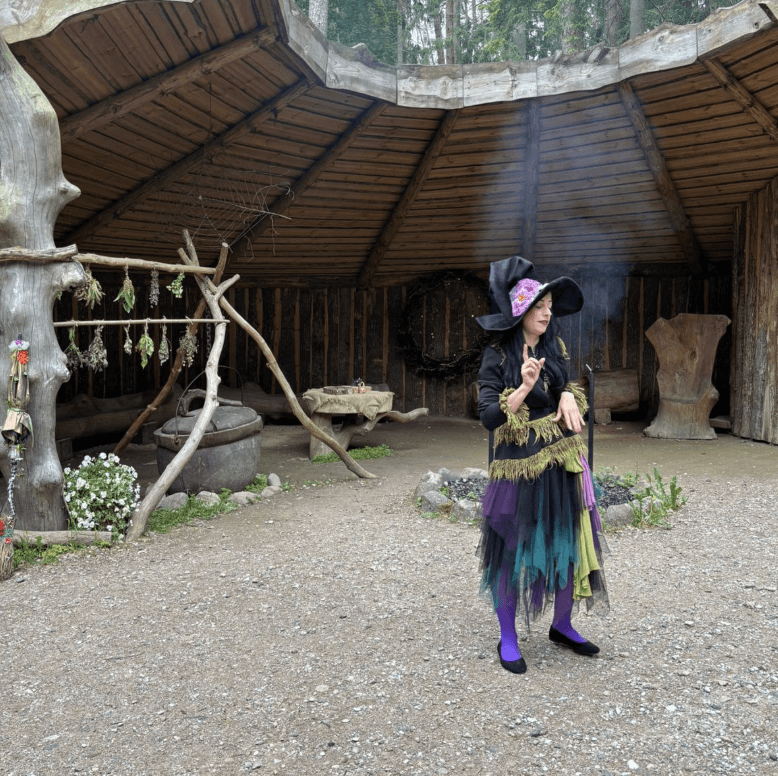
Then we stopped talking to each other and started talking to the people around us. Approaching other visitors as tourists asking for advice got us far more useful answers than a clipboard would have, including two Latvian visitors who had been to Tērvete before. We joined in as well: the witch running her session in the Fairy Forest, the gnome running his in Gnome Town. Doing what visitors do, instead of watching them do it, is what made the gap obvious. The park is full of good moments. Nothing connects them.
What we came back with
"The map is not good. It was really hard to orientate."
Visitor review, Tērvete
"Lots of walking, good for something to do with kids, but lame for couples."
Visitor review, Tērvete
"I don't know about the author or the fairy tales."
Latvian-speaking repeat visitor, Tērvete
Back in the classroom on day two, what we had seen on foot was joined by public visitor reviews and LVM's own audience data. With no time for anything more formal, we treated those three sources as the brief.
Six worlds, one map
Six worlds, each with its own characters and stories…
Lost, not led
Visitors couldn't tell what they were walking toward, or why.
A story scattered
Even a Latvian-speaking repeat visitor left without knowing Anna Brigadere or her fairy tales.
Audiences unreached
52% of visitors are families or preschoolers, yet nothing was designed for adults, couples, or international guests.
We stopped trying to design a better map.
Walking the park three ways made the problem specific in a way the brief hadn't. Tērvete doesn't lack things worth seeing. It lacks a reason to go from one to the next. A better map would have made the park easier to cross, and left it just as arbitrary to walk through.
What if the story did the navigating?
Anna Brigadere's fairytale was already distributed across the park, in the statues and the zones and the characters. It just wasn't being used as anything. Treated as a narrative arc rather than as decoration, it gives a walk a beginning, a middle, and an end: the one thing a map can't supply.
What we saw, and what we did about it
Lost, not led
One map for 1,200 ha left visitors without direction or purpose.
A story scattered
The fairytale sat in fragments across the park, told only in Latvian.
Audiences unreached
Designed for families, with nothing for adults, couples, or internationals, and no reason to return.
Personalise the route
A kiosk-generated trail matched to each visitor's time, group, and interests: service infrastructure instead of the physical construction that Natura 2000 ruled out.
Make the story the wayfinding
Anna Brigadere's narrative arc becomes the navigation logic: each stop a chapter, each cue language-neutral, so the tale finally gets told to everyone.
Separate trails, not one route
Adventure and Nature Lovers trails plus collectible mechanics give new audiences their own experience, and deliberately leave something unfinished for next time.
A trail built at the entrance, not printed in advance.
A kiosk at the entrance generates a route around your time, your group, and your interests. The fairytale threads the zones together, and a layer of collectibles gives you a reason to finish the route and a reason to come back for a different one.

Concept visualisation — AI-generated from our sketches.
1 · Plan your visit at the kiosk
Pick a language and answer a few questions: who you are with, how much time you have, how far you want to walk, and what draws you to the park. You leave with a route, printed or on your phone, along with your first collectible.
2 · Follow a trail shaped for you
Routes are built around your time, energy, and interests and cover different thematic zones of the park, from the Fairy Tale Forest to the Old Pine Park.
3 · Collect the story as you go
Postcard cutouts, kasane-oshi stamps, and scavenger hunts turn the walk into something you take part in. Each leaves something unfinished on a first visit.
Where the team disagreed
Two of us, myself included, argued for keeping Sprīdītis as one trail among several: the fairytale route for people who want the story, with separate routes for hikers, nature visitors, and anyone who needs an easier walk. Our third teammate made the case for folding everything into a single Sprīdītis route, so that every visitor got the story no matter why they came.
We went with separate trails. The brief asked us to reach past families and school groups, and one fairytale route would have handed every adult, every couple, and every international visitor a children's story whether they came for it or not. The integrated version was the more coherent product; ours answered more of the brief.
Zoom in · the Sprīdītis trail, in four stops
The fairytale route traces Anna Brigadere's story through four moments in the park. Each stop is a chapter; the path between them is the thread that was missing from the existing signage.
It starts at Sprīdītis's door
The trail opens at the storybook house, a known landmark that sets the tone and gives every visitor, regardless of language, the same clear starting point in the fairytale.


Route to Gnome Town
Visitors meet the gnome woodworkers, the craftsmen of Tērvete's forest world. The Gnome Forest is the most popular zone with children, and placing it second keeps early momentum while grounding the woodcraft heritage.
Into the Fairy Forest
The heart of Anna Brigadere's world: the Forest Mother, the Forest King, the Witch, and Stingy. This is the zone where we joined the witch's activity ourselves, and it works without any prior knowledge of the story or the Latvian language.

Concept visualisation — AI-generated from our sketches.
The finale: Mājās
The loop returns you home. A wooden slide carries you to a framed mirror that reflects you and your family back. Built on the peak-end rule: the moral of the fairytale is felt rather than explained, and no Latvian is required to understand it.
The collectibles
Three lightweight mechanics sit on top of the trails. Each works without language, and each leaves something unfinished the first time.

Postcard cutouts
Cards frame the real wooden statues inside a fairytale scene, turning every character into a photo opportunity. The woodcraft heritage gets the spotlight; visitors take the story home.
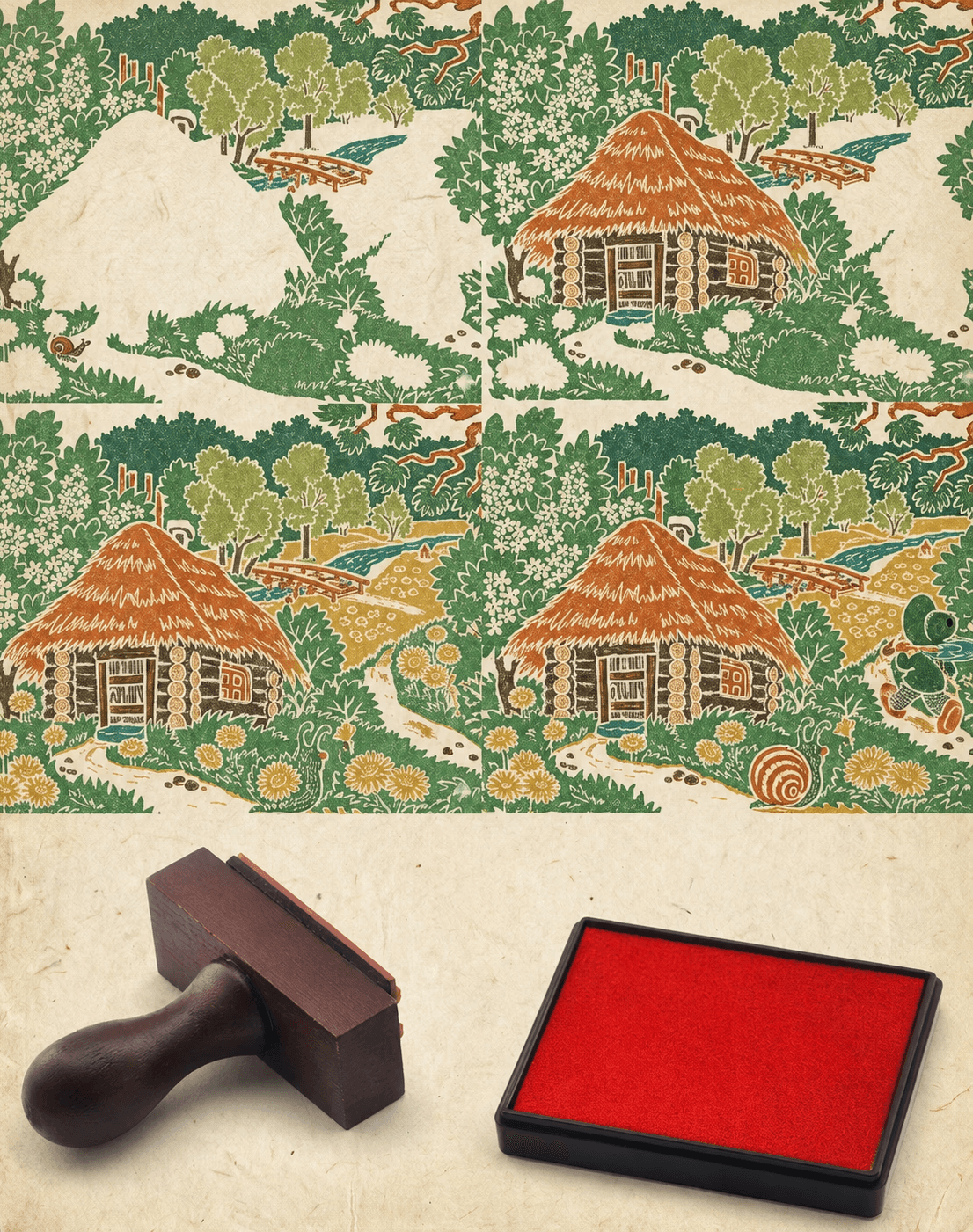
Kasane-oshi stamps
Stamps at each trail stage combine into a single souvenir image, completed only by walking the full route. The incomplete set is what brings people back.

Concept visualisation — AI-generated from our sketches.
Scavenger hunts
Story-based quests built around statues, artefacts, and the park's natural details. A gamified layer that works for families on a first visit and adults revisiting alone.
And one idea for the empty months
The brief asked for new revenue, and a park that earns from April to August can't be Europe's leading forest destination. I proposed the Anna Brigadere artist residency: artists live and work in the park from autumn to spring, and their open studios, workshops, and showcases become the reason to visit when the trails go quiet.
A one-season park
The insight
The park's assets aren't seasonal. Only its visiting model is.
The Anna Brigadere Residency
For visitors
A living park in every season: open studios, make-and-take workshops, artist talks, and an end-of-season showcase.
For LVM
Revenue independent of summer footfall, and a new position as patron of Latvian creative heritage rather than only a forestry operator.
For artists
An open European call across woodcraft, writing, illustration, land art, and design. Four tracks, detailed below.
The jury judged it against the brief. So do we.
Two days of work can't claim visitor metrics. What it can be measured against is the five objectives LVM wrote down, which is the same test the jury applied.
Improve navigation
Encourage return visits
Attract international audiences
Create new revenue streams
Expand beyond families
We won a pitch. That isn't the same as being right.
Three things I'd want to say plainly about what this project is and isn't.
The constraint did the best design work
Natura 2000 ruled out building our way to a better experience. That pressure is what pushed us into the service layer, which turned out to be the lighter, cheaper, and more interesting answer. I didn't choose that framing; the protected land did.
Story structure is infrastructure
My journalism background usually shapes how I present work. Here it shaped the work itself. A narrative arc turned out to be a legitimate wayfinding system, and that's the transferable idea I took away.
What I'd test first
Three hours in a park and a set of public reviews is a thin evidence base. The honest next step is a kiosk-flow prototype and a one-zone stamp trail, tested with the adults and international visitors the park most wants to reach and the ones we had least contact with.
The forest was already full of stories. The design just had to make them findable.
Designed with Sara Sanwal and Fanny Verástegui as Team Gnomes, in response to the SDSI 2026 Hackathon brief from Latvijas Valsts Meži.