Discover your scent through every sense.
Fragrance is deeply personal, yet choosing one is mostly guesswork, and for the one in five who can't fully rely on smell, not even that. Soirée rebuilds discovery on touch, taste, and test, so every sense helps you decide with confidence.

Concept visualisation — AI-generated from our sketches.
Fragrance is personal, but discovery is broken.
Soirée was our response to the L'Oréal Brandstorm 2026 challenge. Fragrance is one of the most emotional categories in beauty, tied to identity, memory, and self-expression, yet the way people discover it does not support confident decisions, especially in a luxury context where expectations are high. Where L'Oréal Luxe brands already use AI quizzes to personalise selection, Soirée starts at the next step: it rebuilds sampling around more than smell, so people decide with real conviction rather than a recommendation, and so those who can't rely on scent aren't left out. I led the UX research and the product design that shaped the concept.
Brief
L'Oréal Brandstorm 2026
Year
2026
My role
Lead UX Researcher & Product Designer
Team
Catherine Martin, Sara Sanwal, Karla Victoria Maiden-Vazquez
Deliverables
The gap was not just choice. It was confidence, access, and follow-through.
Blind discovery is costly and, for many people, not even possible. The research made both problems measurable.
Sources
Findings · the numbers
€0
spent on regretted fragrance purchases over three years
0%
still rely on traditional in-store sampling
0%
want a more meaningful discovery experience
0%
of people, one in five, live with some form of smell disruption
In their words
“I want a discovery experience that helps me emotionally connect, something that lets me understand how it makes me feel.”
Survey participant
From pattern to decision
Blind buying
People choose almost entirely on guesswork, with no way to trial a fragrance before they commit.
A single-sense category
Discovery relies on smell alone, leaving the 1 in 5 with some form of smell disruption no way in.
Guidance stops at checkout
A fragrance performs differently with skin, mood, and occasion, but advice doesn't follow the purchase.
Confidence before purchase
Test lets people trial the actual fragrance on skin first, so the decision is informed, not hopeful.
Multi-sensory discovery
Taste and touch build a felt, emotional connection to a scent that doesn't depend on smell at all.
Ongoing support, in-app
The digital companion guides wear, performance, and reapplication long after the sale.
How might we build fragrance discovery on more than smell alone, so the people who can't rely on it, and the many who can, both decide with confidence?
Solving discovery meant designing for the whole arc: choosing with confidence, performing beyond the purchase, and belonging regardless of how well you smell.
Soirée doesn't replace smell.
It lets every sense have a seat at the table.
If scent alone leaves people uncertain, and excludes those who can't rely on it, then discovery shouldn't rest on a single fragile signal. Bringing touch and taste alongside scent gives people more than one way to understand a fragrance, builds the confidence that recommendations can't, and makes the category accessible to far more people. Three principles guided the design from there.
Engage more senses
Translate a fragrance into touch and taste so a decision rests on real, felt experience, not a single sense or a screen.
Build confidence
Guide people through scent, with cues they can trust, so discovery feels assured rather than like a gamble.
Design for access
Offer emotional proxies for people who can't rely on smell, so inclusion is built in, not bolted on.
One kit, three senses: Touch, Taste, and Test.
Soirée is a multi-sensory discovery system that guides people from discovery to real-life use, layering a physical and digital experience that builds confidence not just in choosing a fragrance, but in experiencing and wearing it.
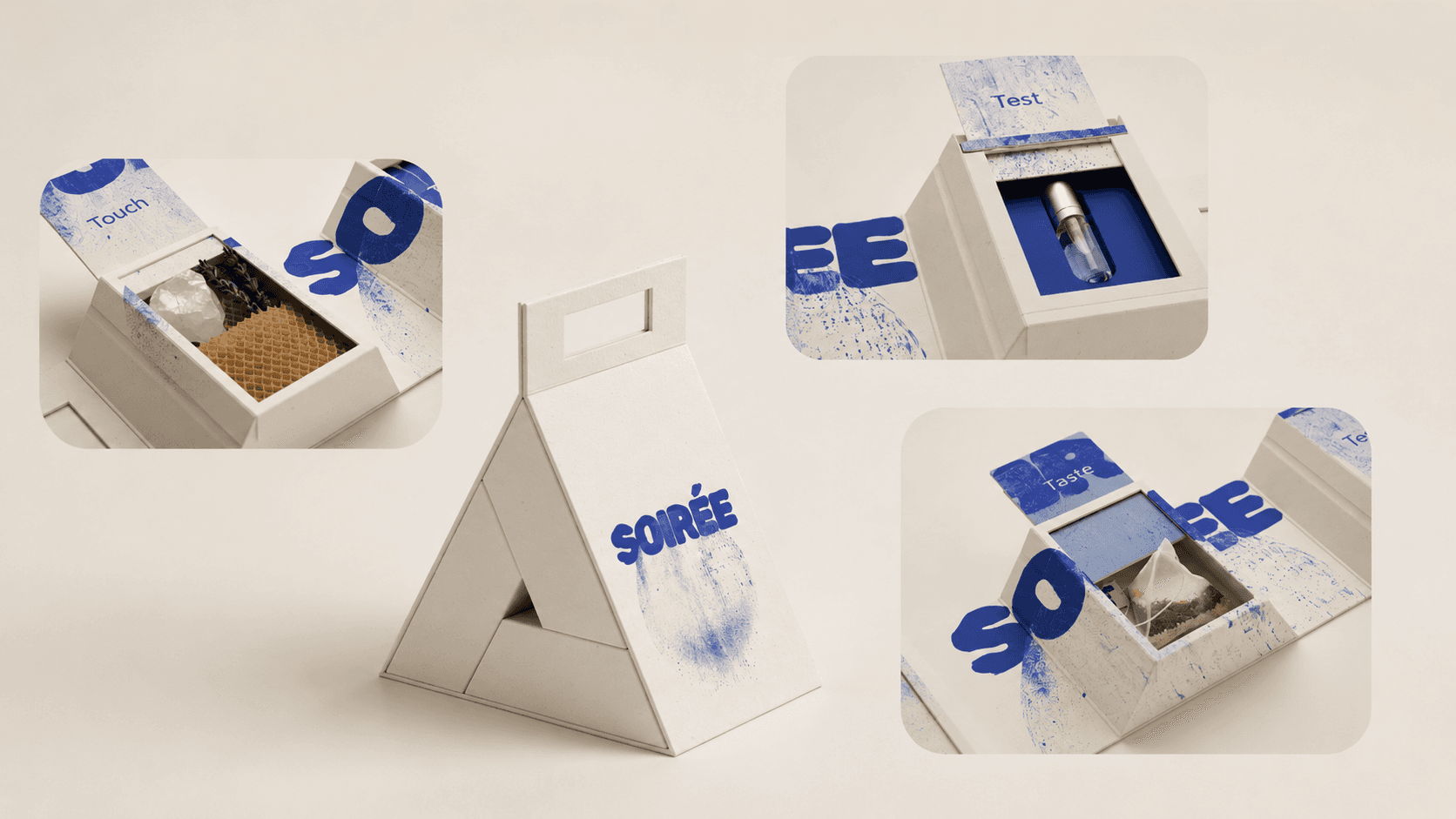
Concept visualisation — AI-generated from our sketches.
The experience, end to end
The kit arrives
Three fragrances to discover, ordered online or gifted.
Prime
A QR soundscape sets the mood before anything opens.
Touch
A texture translates the fragrance's mood into feeling.
Taste
The pyramid bag dissolves top, heart, and base in order.
Test
The sample vial goes on skin, with full sensory context.
The three senses, up close
Touch
Selected natural materials and textures translate the fragrance's mood into physical sensation: softness, warmth, boldness, or lightness. An immediate, non-olfactory way in.
Taste
A biodegradable pyramid infusion bag lets people taste a fragrance's top, heart, and base notes dissolve in sequence, primed by a short audio soundscape from the QR on the tag.
Test
The sample vial goes on last. Instead of guessing, people experience the scent with full sensory context and decide with confidence.


Product design · what I made
I led the product design that shaped Soirée, the kit architecture, the packaging, and the way the three steps unfold in the hand. The goal was to make an abstract, multi-sensory idea feel real and premium enough for judges and stakeholders to understand at a glance.
Guidance that continues after the purchase, not just before it.
The companion is built into existing L'Oréal Group brand apps, no new platform to maintain. Once the Soirée kit is purchased it is automatically registered in the user's profile, unlocking a guided testing experience for each fragrance sample. The same system can extend to any full-size fragrance purchase, so structured guidance reaches beyond the kit.

Context-aware daily wear
Uses location, temperature, and mood as inputs to deliver daily recommendations, answering how to wear a fragrance, not just which to pick.
Understand performance
Surfaces longevity, ingredients, and sillage so people can read projection as subtle, moderate, or strong, answering everyone who wanted to understand how a fragrance evolves.
Wear & reapply guidance
Visual guidance on where and how to apply and layer, plus reapplication reminders based on wear time and conditions, across phone and wearable.
The emotional journey
The companion reduces decision fatigue at the start, structures the testing, and organises purchases into a personalised wardrobe, turning a one-time product into an ongoing relationship.
Built to launch, built to scale, and ready to be tested.
The business case
Launch
Runs on existing L'Oréal operations and brand apps, no new infrastructure.
Infusion outsourced to food-grade pyramid-bag makers for compliance.
QR audio scales globally with no physical production cost.
Scale
Modular across L'Oréal Luxe brands and touchpoints: in-store, e-commerce, PR kits, campaigns.
The companion extends to every fragrance purchase.
Grows from a one-time product into an ecosystem-level solution.
Economics
€45–75 retail price range, around €55 at launch.
≈ €22 cost of goods.
≈ 60% gross margin, in line with luxury beauty.
How I'd validate it next
Soirée is a concept built on strong research, and the honest next step is to test the riskiest assumptions before scaling. I'd want to know whether the multi-sensory experience genuinely changes confidence, not just whether people enjoy it.
Test 01
Does taste build confidence?
Run the full kit with real users and compare decision confidence against standard sampling, the core claim to prove.
Test 02
Does it work without smell?
Test with people who have anosmia or hyposmia to check whether touch and taste are genuine proxies, not decoration.
Test 03
Is the note translation legible?
Validate with L'Oréal R&D that the top, heart, and base structure reads clearly in taste, the biggest technical unknown.
Where it landed
Soirée didn't make the Brandstorm 2026 selection. The work still earns its place here: a 104-person study across three regions, a concept grounded in real material logic, and a validation plan I'd run tomorrow if the pilot existed. What it taught me is in the reflection below.
What I owned.
UX research
I led the 104-participant study across Asia, North America, and Europe, turning the findings into the confidence-and-access insight at the core of Soirée.
Product design
I led the product design for Soirée, shaping the kit, the packaging, and how the three sensory steps unfold in the hand.
Collaboration
I worked alongside Sara Sanwal and Karla Victoria Maiden-Vazquez, leading the research and product design while sharing the broader concept work.
What I'd carry forward.
Soirée pushed me to design for a sense you cannot show on a screen, which forced a different kind of rigour. Translating scent into touch and taste meant the concept had to be grounded in real material and chemistry logic, not just a nice story, and that taught me how much credibility a bold idea borrows from being genuinely feasible.
It also reframed accessibility for me. Designing for the one in five people who can't fully rely on smell wasn't a side feature, it made the whole concept stronger. I now start from who a category leaves out, because that's often where the most original design moves are hiding.
You can't smell a screen. Soirée gives every sense a seat at the table.